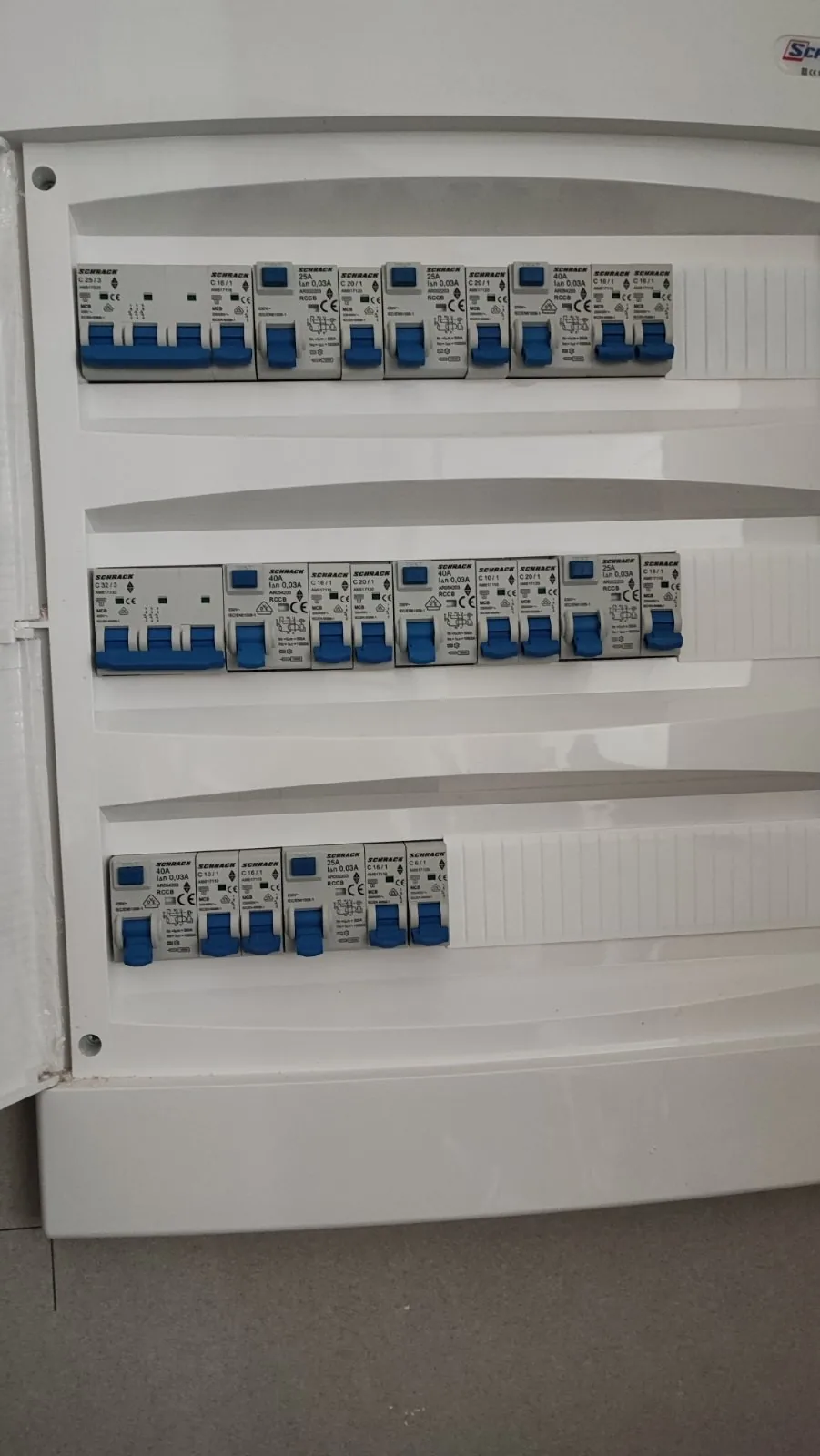


Residual current protection is one of the key safety elements in a modern electrical installation.
To many people, an electrical panel looks like a row of similar devices. In reality, different protective devices perform different tasks.
A circuit breaker mainly protects a circuit against overload and short circuit, while a residual current device monitors for current leaking away from its intended path.
These leakage currents can be particularly dangerous because they may be too small to operate a conventional circuit breaker.
1. What is a residual current device?
An RCD monitors the current flowing to an electrical load and the current returning from it.
During normal operation, these values should be practically equal.
If part of the current begins to flow through an unintended path — for example to earth, a metal enclosure or through a person — an imbalance appears.
When this imbalance reaches the operating threshold of the device, the RCD disconnects the circuit.
This happens very quickly.
2. Why is a normal circuit breaker not enough?
This is a common misunderstanding.
A circuit breaker is extremely important, but it performs a different function.
Its main purpose is protection against:
- overload;
- short circuit;
- excessive current.
A dangerous leakage current may be relatively small and may not cause a conventional circuit breaker to operate.
This is where an RCD provides an additional type of protection.
3. What can cause leakage current?
There can be many causes.
Examples include:
- damaged insulation;
- moisture inside electrical equipment;
- defective appliances;
- damaged cables;
- faults within the electrical installation;
- current reaching a metal enclosure;
- incorrect wiring.
In such situations, part of the electrical current may begin to flow outside its intended path.
4. How can an RCD help protect a person?
Imagine an electrical appliance with damaged insulation where a metal component becomes live.
If a person touches that part, current may flow through the body.
An RCD can detect the imbalance between outgoing and returning current and disconnect the supply.
This does not mean that an RCD makes every electrical situation completely safe or replaces other protective measures.
It is one part of an overall electrical safety system.
5. Where is residual current protection particularly important?
RCD protection is especially important in areas where the risk may be higher.
Examples include:
- bathrooms;
- kitchens;
- laundry rooms;
- garages;
- balconies;
- gardens;
- outdoor outlets.
Moisture and electricity are never a good combination, which makes proper protection particularly important in these locations.
6. An RCD and earthing are not the same thing
These are often confused.
Earthing and residual current protection perform different functions.
A good electrical installation relies on a combination of protective measures.
An RCD should not be treated as a substitute for a missing or defective protective conductor.
Likewise, the presence of earthing does not automatically make residual current protection unnecessary.
7. What does an RCD look like in an electrical panel?
Residual current devices are normally installed in the distribution board.
They often include a button marked:
TEST
T
or a similar symbol.
This button is designed to test the operating mechanism of the device.
Manufacturer instructions should always be followed and the electrical panel should not be used for uncontrolled experimentation.
If there is any doubt about correct operation, the system should be checked by a qualified electrician.
8. Why is the TEST button important?
An RCD is a protective device and should be checked.
The TEST button creates a condition that should cause the device to disconnect.
If it does not operate, this is a sign that the device requires investigation.
However, using the test button does not replace professional testing of the electrical installation.
9. What does RCD sensitivity mean?
Different devices may carry ratings such as 30 mA or other values depending on their intended application.
These values indicate the level of residual current at which the device is designed to operate.
The selection should not be made at random.
The correct device depends on factors such as:
- purpose of the circuit;
- connected equipment;
- electrical system;
- installation design;
- applicable requirements.
For this reason, RCD selection should be part of the overall electrical design.
10. One RCD for the whole home or several?
Different designs are possible.
In more modern installations, circuits or groups of circuits are often divided more carefully.
There is a practical reason for this.
If an entire home is protected by a single device and one circuit develops a fault, power may be lost to a much larger part of the property than necessary.
With a better divided system, identifying and isolating a problem can be easier.
The exact arrangement depends on the electrical design.
11. What is an RCBO?
Combined protective devices are also available that incorporate the functions of a circuit breaker and residual current protection.
These are commonly known as RCBOs.
They can provide protection against:
- overload;
- short circuit;
- residual current.
This can be a very practical solution for individual circuits.
12. Why does an RCD sometimes trip?
If an RCD begins to disconnect the supply, it should not automatically be assumed that the device itself is faulty.
Possible causes include:
- a defective appliance;
- moisture;
- damaged insulation;
- cable faults;
- incorrect wiring;
- accumulated leakage from several devices;
- a fault within the protective device itself.
Repeated tripping is a sign that the cause needs to be identified.
13. Do not bypass the protection
If an RCD trips repeatedly, the worst solution is to remove or bypass it without finding the fault.
The device may be operating because a genuine electrical problem exists.
The correct response is diagnosis.
14. Older electrical installations may not have modern RCD protection
Many older homes were built with different electrical arrangements and may not include modern residual current protection.
During major renovation or electrical rewiring, the entire protection system should be reviewed.
Simply adding one new device to an old installation without checking the rest of the system is not necessarily sufficient.
The following should be considered:
- wiring;
- protective conductors;
- distribution board;
- circuit division;
- electrical loads;
- overall condition of the installation.
15. An RCD does not solve every electrical problem
Residual current protection is extremely important, but it is not a universal solution.
It does not replace:
- circuit breakers;
- correctly sized wiring;
- earthing;
- reliable connections;
- proper installation;
- electrical testing.
Real electrical safety comes from a correctly designed and installed system as a whole.
16. Protection should be planned in new installations
In a new electrical installation, protective devices should be selected together with the circuits and expected loads.
This makes it possible to plan:
- protection for each circuit;
- circuit grouping;
- dedicated supplies for higher-power equipment;
- distribution board layout;
- spare capacity for future expansion.
This is far better than trying to add protection after the renovation is complete.
17. When should you call an electrician?
Professional inspection is advisable if:
- the RCD trips repeatedly without an obvious reason;
- the TEST button does not operate the device;
- the electrical panel is very old;
- you do not know whether RCD protection is installed;
- you are carrying out a major renovation;
- new high-power equipment is being added;
- there may be an earthing problem;
- you feel an electrical sensation from the metal casing of an appliance.
In the last case, the appliance should not continue to be used until the problem has been investigated.
A small device with a very important job
Residual current protection is not something most people notice in everyday life.
Ideally, it simply remains in the electrical panel and never causes any trouble.
But if a dangerous leakage current occurs, it can become one of the most important safety devices in the entire installation.
For this reason, electrical work should not focus only on outlets, switches and lighting.
The protection inside the distribution board is just as important.
Classic EL can assist with the inspection, installation and upgrading of electrical panels and protective devices as part of a complete electrical installation.
Classic EL – a safe electrical installation starts with the right protection
What Is Residual Current Protection and Why Is It Important?