


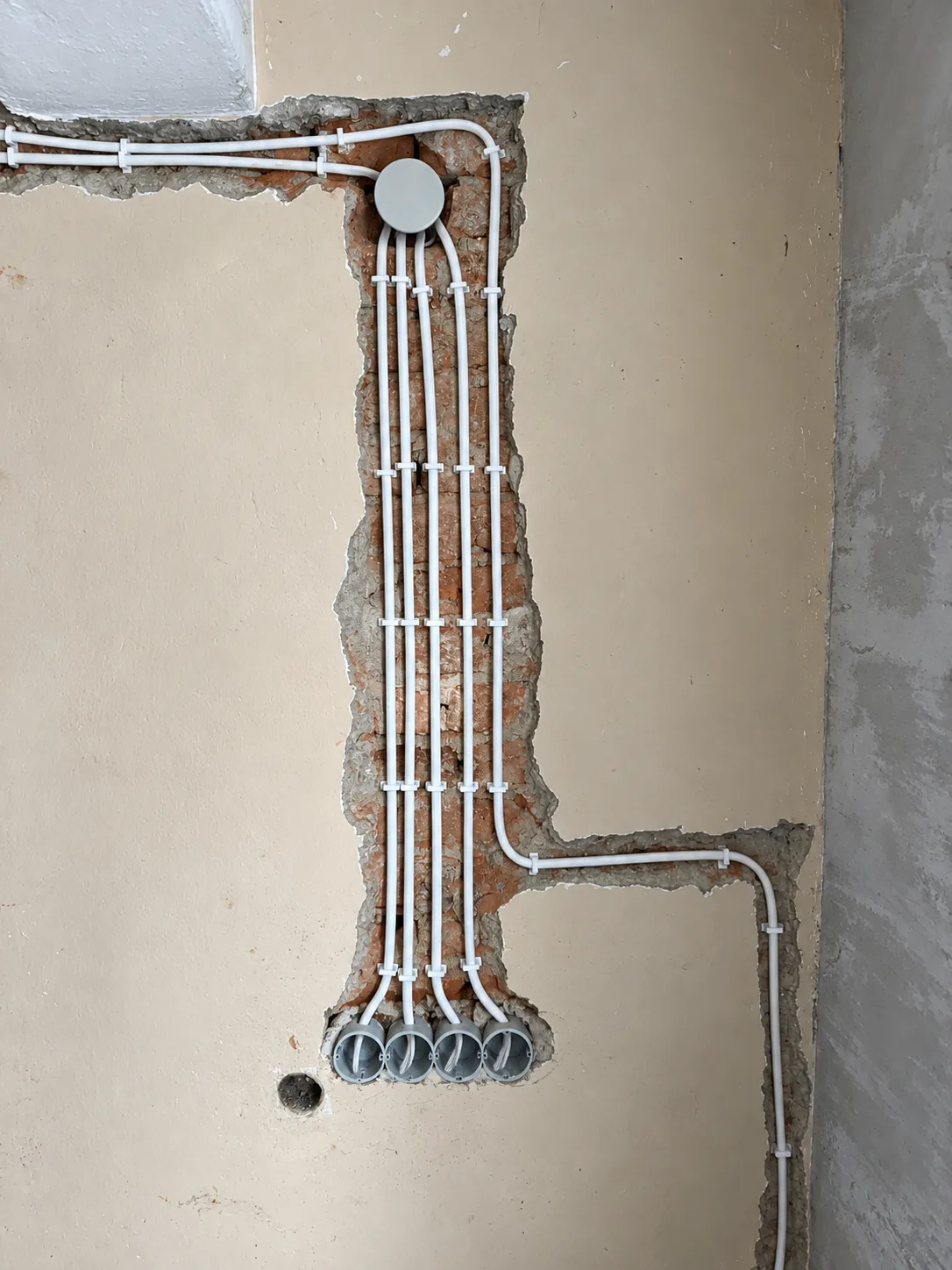
During a major apartment renovation, one important question almost always appears: what should be done with the existing electrical installation?
Sometimes everything appears to be working. The lights operate, outlets have power and breakers are not constantly tripping.
That does not necessarily mean the installation is suitable for modern electrical loads or that keeping it for another few decades is the best decision.
During a major renovation, solving the problem properly can be much more practical than opening newly finished walls again a few years later.
1. Age alone is not the only factor
There is no single age at which every electrical installation automatically needs replacement.
Much depends on:
- the wiring materials;
- quality of the original installation;
- loads placed on the system over time;
- condition of connections;
- distribution board;
- repairs and modifications made over the years.
However, the older an installation is, the more likely it is to contain components that no longer meet the needs of a modern home.
2. If the installation uses old aluminium wiring
Older properties may contain aluminium conductors.
These were widely used in the past, but ageing aluminium installations can create concerns involving:
- deteriorated connections;
- heating;
- mechanical weakening;
- unsuitable connections to newer materials;
- conductor sizes that may not suit modern loads.
Aluminium wiring does not automatically mean that every part of the system is unsafe, but it is a strong reason to inspect the installation carefully.
3. If there is no proper protective conductor
Some older installations were built without the type of separate protective conductor expected in modern electrical systems.
This is an important safety consideration.
Modern appliances and protection systems rely on correctly designed protective measures.
Replacing a few outlets does not solve the underlying issue if the electrical system itself lacks suitable protective conductors.
4. If the electrical panel is very old
The distribution board is one of the first things that should be inspected.
Signs of an outdated panel may include:
- old types of fuses;
- very few circuits;
- no residual current protection;
- no spare capacity;
- unclear or untidy wiring;
- signs of overheating;
- improvised modifications.
During a major renovation, rebuilding the panel may form part of a complete electrical upgrade.
5. If the entire apartment has very few circuits
Modern homes use significantly more electrical equipment than properties did decades ago.
Today we may use:
- ovens;
- electric hobs;
- air conditioners;
- dishwashers;
- washing machines;
- tumble dryers;
- water heaters;
- computers;
- numerous smaller appliances.
If most of the apartment's outlets are supplied by only one or two circuits, the original installation may not have been designed for today's usage.
6. If extension leads are everywhere
Power strips do not automatically mean there is a wiring fault, but they may show that the installation no longer suits the property.
If every room contains:
- extension leads;
- multi-way adapters;
- power strips behind furniture;
- cables running across rooms,
the number and location of outlets may no longer be adequate.
A major renovation is an ideal time to plan electrical points properly.
7. If outlets or switches become warm
A warm outlet, switch or extension lead should not simply be considered normal.
Possible causes include:
- a loose connection;
- damaged equipment;
- excessive load;
- a conductor fault;
- an unsuitable connection.
If similar issues appear in several areas of an older property, the entire installation should be assessed rather than only replacing one accessory.
8. If there are signs of overheating
Discolouration, melted plastic or a burning smell are serious warning signs.
They may appear around:
- outlets;
- junction boxes;
- electrical panels;
- connections to high-power appliances.
In such cases, simply replacing the visible accessory is not enough.
The cause needs to be identified.
9. If breakers trip frequently
Frequent breaker operation can have several causes.
These may include:
- overload;
- faulty appliances;
- short circuits;
- wiring faults;
- unsuitable protective devices.
If the issue occurs repeatedly across different parts of the apartment, the old installation may require more extensive work.
10. If the property is being completely stripped during renovation
This is one of the strongest arguments for considering rewiring.
If the renovation already includes:
- removing finishes;
- opening walls;
- replacing the kitchen;
- renovating bathrooms;
- constructing new ceilings;
- repainting the entire property,
it is an ideal opportunity to inspect and, where necessary, replace the electrical installation.
Doing the same work after the renovation is finished will be much more disruptive.
11. Partial upgrades can create a mixed installation
Many properties have been renovated in stages over the years.
For example:
- the kitchen has new wiring;
- the bathroom has been renovated;
- the living room still uses older wiring;
- the panel has been partly replaced;
- extra circuits have been added later.
The result may be a mixture of systems installed at different times.
This is not automatically a fault, but during a major renovation the whole system should be considered together.
12. New outlets do not mean new wiring
Modern outlets and switches may make the property look new while the old wiring remains behind the walls.
This distinction is important.
Replacing:
- sockets;
- switches;
- decorative frames
does not change the condition of the electrical circuits feeding them.
13. A new kitchen often exposes weaknesses in an old system
The kitchen is where an older installation often faces the greatest increase in demand.
Modern equipment may include:
- induction hobs;
- powerful ovens;
- dishwashers;
- microwaves;
- coffee machines;
- other appliances.
An old circuit originally intended for a refrigerator and one outlet may no longer be suitable.
14. The same applies to air conditioning
When several air conditioners are added, the existing electrical system and distribution board should be assessed for the new load.
High-power equipment should not simply be connected to arbitrary existing circuits without checking whether they are suitable.
15. Complete rewiring allows better circuit separation
A new installation can be planned with dedicated circuits for different areas and loads.
For example:
- lighting;
- general outlets;
- kitchen;
- oven;
- hob;
- water heater;
- air conditioning;
- washing machine;
- other high-power equipment.
The exact design depends on the property.
The advantage is that the system can be built around real requirements rather than continuing to adapt an inherited arrangement.
16. Protection can also be designed properly
Complete rewiring allows appropriate planning of:
- circuit breakers;
- residual current devices;
- RCBOs where suitable;
- surge protection where included in the design;
- circuit grouping.
This is an important part of modernising the property.
17. Future capacity can be included
A new panel and wiring system can also consider future needs.
These may include:
- additional air conditioning;
- smart home equipment;
- CCTV;
- alarm systems;
- network equipment;
- charging devices;
- future kitchen changes.
A well-designed installation should not necessarily use every available option from the first day.
18. How is the decision made?
The most sensible approach is to inspect the electrical installation before renovation begins.
The inspection should consider:
- wiring type and condition;
- distribution board;
- protective devices;
- number and purpose of circuits;
- protective conductors;
- condition of connections;
- expected future electrical load;
- the new layout of the property.
It is then possible to decide whether partial repair is sensible or simply postpones a complete replacement.
19. When can partial repair be enough?
Not every apartment requires complete rewiring.
If the existing installation is relatively modern, correctly installed and in good condition, only specific changes may be needed.
For example:
- adding a new circuit;
- moving several outlets;
- replacing the distribution board;
- adding protection;
- supplying a new appliance.
However, this decision should follow a real inspection rather than simply assuming that the system is fine because it currently works.
20. The most expensive option can be renovating twice
Imagine completing the entire property, installing a new kitchen, painting the walls and then discovering a year later that the old wiring needs to be replaced.
The cost will not be limited to the electrical work.
It may also involve:
- opening walls;
- repairs;
- plastering;
- repainting;
- replacing tiles or finishes.
This is why the electrical installation should be assessed early in a major renovation.
When is complete rewiring a good investment?
Complete replacement makes the most sense when the old system can no longer safely and reliably support the way the renovated property will be used.
It is an investment in a part of the home that is mostly hidden once the work is finished, but which is used every day.
A new electrical installation allows outlets, lighting, powerful appliances and protective devices to be planned as one complete system.
Classic EL can inspect the installation and help determine whether a particular property requires partial electrical work or complete rewiring.
Classic EL – when you renovate properly, what is behind the walls should be done properly too.